
Ethics in Action: Working with Sensitive Data from Scientific Collections
Modern research has developed advanced frameworks and procedures to ensure high ethical standards that protect humans, nature, and cultural heritage. However, when it comes to scientific collections – especially in the field of natural sciences, in contrast to art history and anthropology – researchers often assume that these materials are largely “unproblematic” and that ethical issues are minimal. After all, they are simply plants, animals, or rocks collected tens or even hundreds of years ago – what could be wrong with that?
Yet, as soon as one begins examining collection practices and historical contexts, many complex ethical issues become apparent. These include colonial histories of acquisition, power imbalances, overlooked Indigenous rights, the reproduction of discriminatory stereotypes, potential risks to endangered species, and the complex interplay between nature, human history, and contemporary politics.
Frameworks such as the CARE Principles for Indigenous Data Governance and the co-management of artifacts and natural objects with communities of origin address some of these concerns; however, they also introduce further complexity to the governance and use of related data. A comprehensive framework to simultaneously address multiple ethical issues is currently lacking.
In this seminar series, we will explore the ethics of data derived from scientific collections, covering topics ranging from dinosaur fossils to looted artefacts, as well as threatened species and genetic resources. Our panel of excellent speakers will highlight the importance of understanding the historical and ethical context of collection data, discuss the challenges of working with such materials responsibly, and present practical approaches and tools for addressing these complexities. The series aims to foster dialogue and collaboration towards more just, transparent, and responsible practices in the management and use of collection data.
All sessions will be held online and in English. Participation is free, but registration is required. Please note that the sessions take place on different weekdays and at different times. See table below for details.
[1] Data in Society and Datafication: Who Cares About Data?
Data ethics is not a list of principles or guidelines to follow in order to ‘get data work right’; it is a way of reasoning and an ability to explicitly evaluate and defend specific strategies and decisions, and why one thinks – under specific circumstances and at a particular time – that these are the best strategies and decisions given one’s values and goals. Accordingly, this session is dedicated to understanding how data works and its dynamics, to be able to situate ethical reasoning within an adequate epistemic framework. This includes the key ethical questions around the use of Big Data and associated technologies such as Machine Learning and Artificial Intelligence, and the broader framework of contemporary digital society, including its reliance on automation, generative AI, social media and related platforms for communication and service provision.
Speaker: Prof. Sabina Leonelli (Munich Technical University / Ethical Data Initiative)
Date: April 21st, 1:15 pm – 2:40 pm CET
Infos & Registration
[2] How to approach contested natural history holdings and their data? Case studies from Museum für Naturkunde Berlin
The Museum für Naturkunde Berlin (MfN) houses approximately 30 million objects, a significant proportion of which were acquired through expeditions conducted in colonized territories or submitted by colonial actors.
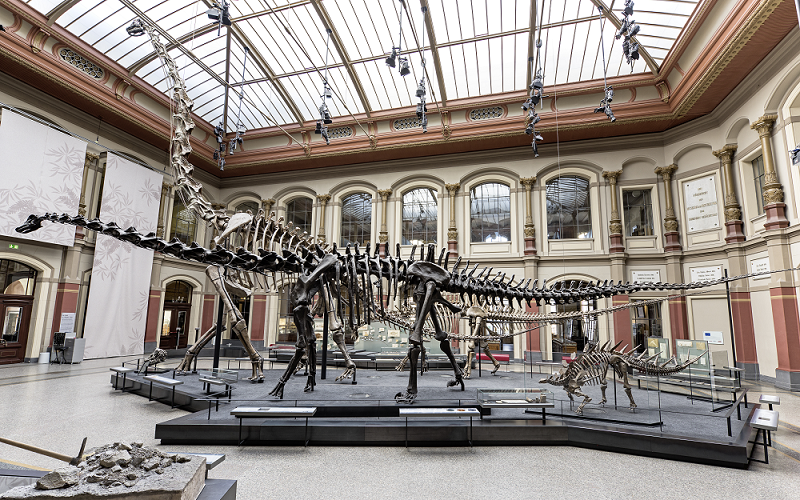
Against this historical backdrop, the question arises as to how the institution can engage responsibly and sensitively with this legacy. The seminar addresses this challenge through two case studies. First, we present a decision-tree model designed to support collection-based research by identifying objects with colonial context. Second, we introduce an ongoing project dedicated to the digitization of the Tendaguru fossils. In fact, one of the institution’s most iconic exhibits is the Giraffatitan brancai dinosaur fossil, which originates from excavations at Mount Tendaguru, carried out between 1909 and 1913 in what was then the German colony of German East Africa (present-day Tanzania). This enormous dinosaur specimen exemplifies the large-scale colonial collecting practices that shaped its holdings as the excavation was made possible through the labor of hundreds of African workers, resulted in the recovery and transport of approximately 200 tons of fossils to Berlin.
When dealing with data from such contested objects, the central question is: How can these contexts be presented on a metadata level? Which ethical and legal aspects need to be taken into account when dealing with colonial data? By bringing these questions together, the seminar aims to demonstrate that both critical reflection and careful digital curation of such collections constitute iterative processes that must be understood as research in their own right.
Speaker: Katja Kaiser (MfN), Ina Heumann (MfN)
Date: April 29th, 2:00 pm – 4:00 pm CET
Infos & Registration
[3] The making of biodiversity data: collection digitization and its politics in natural history museums
In light of the recent surge in projects aiming to mass-digitize collections, this talk reflects on processes and practices of data production in natural history museums. It in particular pays attention to the politics of these practices: the power indifferences and sociopolitical conditions that become clear from looking at what work is done by whom, which data are deemed valuable to record, and who decides on the investment in- and shape of digitization processes. The talk argues that these socio-material conditions of data production matter to how data is processed and made available, and as such to how biodiversity crises are approached and managed. Besides reflecting on processes of data production, the talk thus explores how “solutions” to crises of species extinction and biodiversity loss are given shape through mass-digitization projects at natural history museums.
Speaker: Dr. Roos Anne Hopman (Klagenfurt University)
Date: May 6th, 2:00 pm – 4:00 pm CET
Infos & Registration
[4] International Obligations on Access and Benefit-Sharing (ABS): What Collections and Researchers Need to Know
Speaker: Melania Muñoz García (Leibniz Institute DSMZ), Monique Hölting (Museum Koenig Bonn), Dr. Martin Wiemers (Senckenberg Society for Nature Research)
Date: May 12th, 10:00 – 11:30 am CET
Infos & Registration
[5] The Hidden World of Sensitive Species Data
The growth of biodiversity data aggregators and citizen science projects over the past two decades has led to an exponential expansion in the application of big data to conservation assessment and biodiversity research. Subsequently, expectations that biodiversity data should be made available have risen, as has the recognition of the challenges of both releasing and not releasing Restricted Access (sensitive) species data (RASD).
As biodiversity data has been democratised, the motivations of individuals, researchers, and organisations in restricting access to certain types of data have remained constant. Data producers and custodians may have a more conservative view of access than data consumers. Factors to be taken into consideration include type and level of threat, vulnerability, type of information, and public availability. Additionally, there is a growing recognition of the need to enable Indigenous peoples and local communities to assert data sovereignty over traditional knowledge and biodiversity data gathered by, about or within areas managed by them.
Restricted access species data requires constraints on (constrained) shared access to meet conservation, legal and legislative requirements. Access to this data is essential for improved environmental and research outcomes, better evidenced-based decision-making and reduced regulatory timeframes (improved environmental and research outcomes).
This session will explore the hidden world of sensitive species data. It includes an explanation of the difference between threatened and sensitive species, what factors may be considered when listing a species as sensitive; how sensitive species may classified; the types of treatments which may be applied to RASD, and how the Atlas of Living Australia manages RASD.
Speaker: Tania Laity (Atlas of Living Australia), Cam Slatyer (CSIRO)
Date: May 21st, 9:00 – 11:00 am CET
Infos & Registration
[6] From Vaults to Relationships: Indigenous Data Sovereignty and the Future of Biocollections
Speaker: Dr. Leke (Leslie) Hutchins (Arizona State University)
Date: June 4th, 10 am – 12 pm CET
Infos & Registration
[7] Reconnecting Cultural Heritage: Digital Infrastructure for Provenance, Community Knowledge, and Restitution
Digital Benin is an international digital humanities project that brings together dispersed collections, archival records, and images of royal artefacts from the Kingdom of Benin, providing an unprecedented overview of objects looted in the late nineteenth century by British forces and now held in museums worldwide. Building on five years of collaboration with more than 250 institutions and dozens of expert partners, the project not only aggregates data but foregrounds provenance research, community knowledge, and restitution pathways.
From this work emerged Ọkpan – Origin Knowledge Platform for Assembled Narratives, an open-source software designed to address structural challenges in heritage data. Ọkpan enables institutions and communities of origin to link and enrich museum datasets without altering original records, integrating indigenous languages, oral histories, and community-based knowledge. Centering origin communities as primary knowledge holders, Ọkpan supports collaboratively assembled narratives that reconnect fragmented object histories across collections and geographies.
This seminar introduces both Digital Benin and Ọkpan, presenting their conceptual foundations, technical features, and ethical framework, and discussing how digital infrastructure can support restitution, shared authority, and more accountable forms of heritage stewardship.
Speaker: Dr. Anne Luther (Institute for Digital Heritage / Digital Benin)
Date: June 11th, 4:30 – 6:30 pm CET
Infos & Registration
[8] A Digital Repertory of Colonial Plunder
This session is an introduction to core issues that arise when encoding looted African cultural heritage and histories of colonial spoliation on digital data platforms. With three exemplary cases developed by the Wikidata project “The Restitution of Knowledge: A Digital Repertory of Colonial Plunder“, the participants will get familiar with object-centered, agent-centered and event-centered approaches to digital provenance. They will be invited to examine the ethical issues linked to one-to-one transfers of museum databases to online platforms, and to reflect of possible solutions to provide a plurality of perspectives (including oral historical records) in referencing the provenance or context of acquisition of African cultural heritage.
Speaker: Dr. Yann LeGall (Technical University Berlin)
Date: June 18th, 11:00 am – 13:00 pm CET