
Strictly speaking, this series of blog posts focuses on just one very specific sub-category of OER – self-paced courses.
In other words, learning materials that learners can work through at times of their own choosing and at their own pace. There are no external structures, no (visible) fellow learners, and no opportunity to ask questions along the way or receive direct, personal feedback.
And even if you were able to choose the topic yourself (which isn’t the case with every online course, but is likely to be so in the context of WiNoDa), it takes a great deal of intrinsic motivation to sit through a course on a Tuesday evening – alongside your main job, research, work, care responsibilities, family and sport – rather than enjoying what little “free time” you have.
The course creators on the WiNoDa team are well aware of this, which is why we’ve been thinking about how to present the appropriate density of information in a way that strikes the balance for our target audience appropriately. We could simply post PDFs with long blocks of text full of technical jargon – we know the community can handle that. But do they really want to deal with the same things they encounter so often at work after they’ve finished for the day? So what options are there for creating less boring courses?
We discussed this last year in a series of internal workshops.
One solution would be gamification.
Gamification refers to the use of typical elements and principles from the world of (video) games in other contexts. These include points/scores & leaderboards, levels & progress bars, rewards (badges & trophies), and quests & challenges.
However, we very quickly decided against widespread gamification of our teaching materials and adopted only a few of the features.
Scores tend to evoke exams and grades. But our quizzes are intended to be a feedback tool – that topic is well understood, this material hasn’t quite sunk in yet. Each quiz can be retaken as many times as needed until everything is understood. Progress to the next lesson isn’t dependent on passing a test. So no scores, no passing grades.
Rankings lead to comparing oneself with others – and comparison makes people unhappy. There may be people whose ambition is sparked by this. But education and personal development is not a competition. Furthermore: data protection. It is nobody’s business who else is taking the same course, at what pace, and with what results.
We do, of course, specify the course level. Those who already have advanced knowledge shouldn’t be left bored by a beginner’s course. Conversely, no one should be faced with topics or exercises where the basics are completely new to them. That is why we strive to provide a clear description of the level, the learning objectives and, where applicable, the progression of content for all our courses. We leave the assessment of their own level to the participants – they will surely realise for themselves whether they are being challenged too much or too little.
Progress bars are useful when you need to work through extensive materials. For every Moodle course, we display whether the assigned activities have been completed. Unfortunately, our decision to bundle all the content of a course or course section into a single H5P course portfolio, and our further decision to offer courses that were originally planned as monolithic units as a series of modular individual courses, somewhat runs counter to this. Oh well. There are page numbers, after all…
Quests & Challenges – well. We strive to incorporate practical exercises, and that can sometimes be challenging. Perhaps you have to look up some information on a website in order to provide the correct answer to a quiz – but does that really count as a quest? We also use our personas as characters with whom learners can identify, but that doesn’t make them avatars…
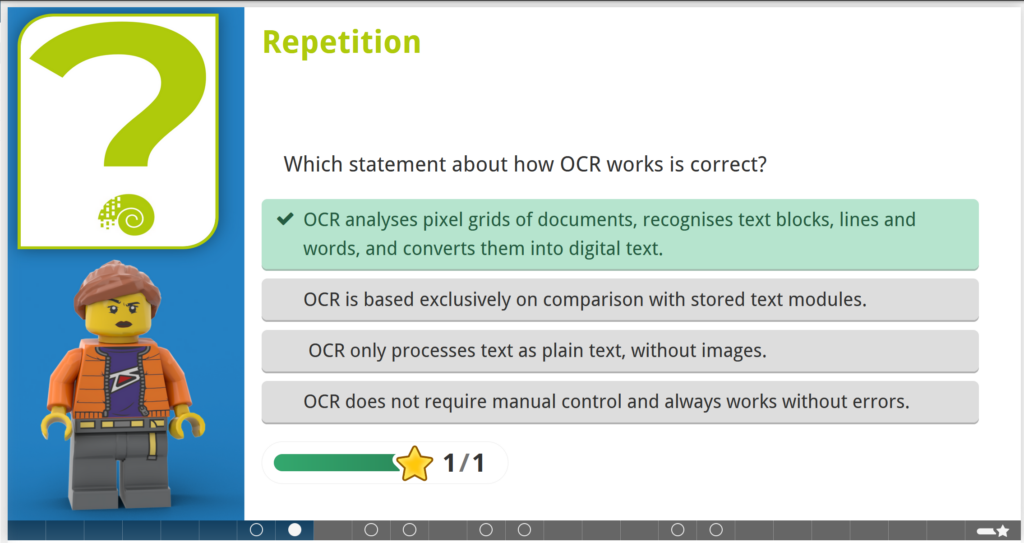
Rewards. The greatest reward is the knowledge you’ve gained. Obviously– but even so, many adults still enjoy the equivalent of reward stickers, smileys and little stamps. Fortunately, all H5P quiz elements offer built-in encouragement in the form of a green tick or a golden star. Automated feedback can often be included as well. Well done!
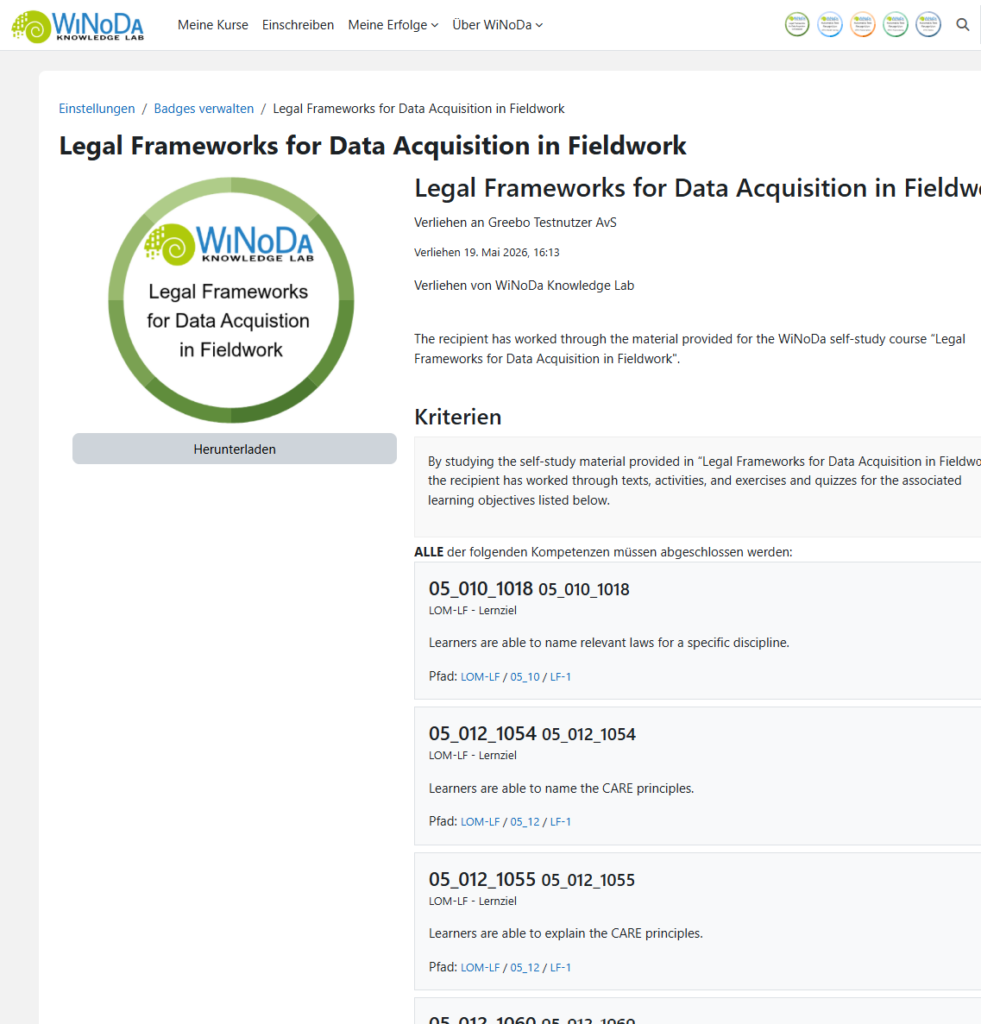
We also use badges, but not as collectables or rewards. They are linked to a list of learning objectives (as per the learning objective matrix) that were covered in the completed course. Badges earned are displayed in the navigation bar. Clicking on them reveals the list of learning objectives. This gives participants a clear overview of the content covered.
We have, meanwhile, completely dispensed with (virtual) trophies. However, anyone who wishes to or needs to can download a certificate (with a verification code).
The key word when it comes to our decisions regarding the incorporation of gamification elements is, of course, the little word ‘appropriate’, which has been mentioned twice above. Appropriateness – aptum – is the key to success in ancient rhetorical theory. With a group of participants whose ages, disciplines and prior knowledge are completely unknown to us, but who are likely to be very diverse, we had to strike a balance between being academically dry and playfully frivolous.
In a classroom, I can flexibly adapt the level, examples and tone of my course – but that’s not possible in the somewhat abstract space of an unguided online course.
Even within our own team, there were very different preferences and ideas. This will also be reflected in the various courses. Ultimately, we’ve all had to guess a bit as to what you might expect – and we hope we’ve got it right.
Feel free to sign up, give it a go and let us know if it works for you!
You can find WiNoDa self-study courses at www.moodle.winoda.de
(Registration required.)
Published so far:
- The Basics of Automatic Text Recognition (ATR). A four-part introductory course. Estimated duration: 4–6 hours (for all four parts).
- Legal Frameworks for Data Acquisition in Fieldwork. Introductory course. Estimated duration: approx. 1 hour.

All course materials are in English.
As an academic staff at the DAI, my main responsibility for WiNoDa lies in the creation of self-study courses on discipline-specific data literacy.
Hands-on and interactive – my goal is: less technical jargon, more “aha” moments.
Because we are all working with data!