
You have been told by the funder that your research project needs a Data Management Plan, or DMP.
Fair enough.
Then you start looking for a tool to create one.
Suddenly there is ARGOS. DMPonline. DMPTool. RDMO. Data Stewardship Wizard. easyDMP. GFBio DMP Tool. DataPLAN. ARIADNE. And several more.
They all seem to help with data management planning, but they are not all designed for the same researchers, disciplines, or workflows.
So where do you start?
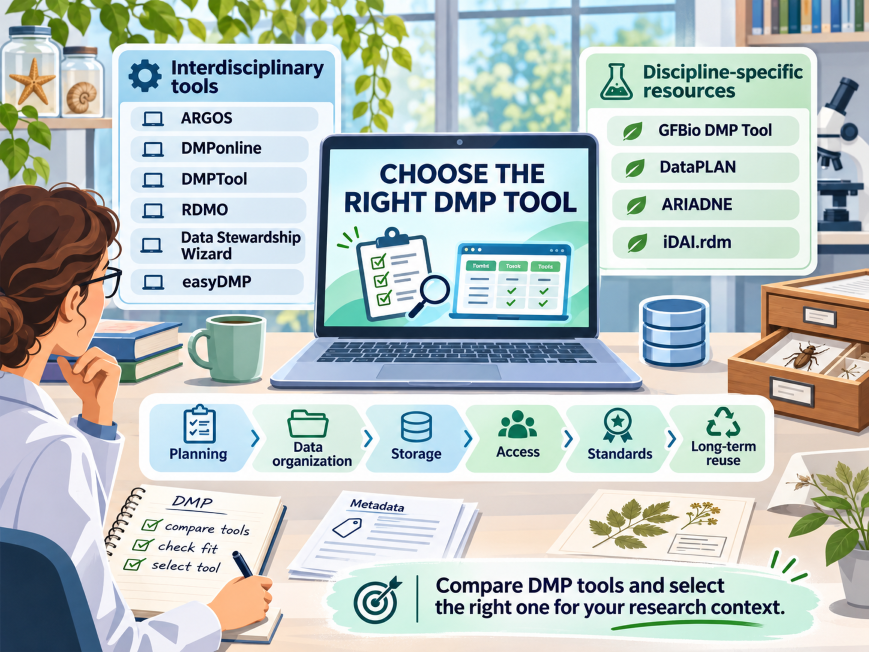
A DMP tool should fit your research.
A Data Management Plan helps you think through what will happen to your research data during and beyond a project.
- How will the data be organised and documented?
- Where will it be stored?
- Who can access it?
- Which standards should be used?
- What happens when the project ends?
The questions may be similar across disciplines, but the answers often are not.
A researcher working with natural science collections may need to think about specimen data, metadata standards, persistent identifiers, sensitive locality information, or data publication.
An archaeologist may have different disciplinary requirements.
Plant scientists may work with specialised templates and infrastructures.
And sometimes a broadly applicable, interdisciplinary DMP tool is exactly what you need.
That is why choosing a DMP tool should involve more than picking the famous DMP tool used by many.
One landscape, many approaches
To make the choice a little easier, we have compiled a practical overview of Data Management Plan tools and resources in the GFBio Knowledge Base.
The overview includes widely used interdisciplinary platforms such as
- ARGOS
- DMPonline
- DMPTool
- RDMO
- Data Stewardship Wizard
- easyDMP
It also includes more discipline-orientated options, such as the GFBio DMP Tool for biodiversity research, DataPLAN for plant science, ARIADNE DMP tools for archaeology, and iDAI.rdm, an archaeology-specific implementation based on RDMO. The point is to help you understand what kind of tool you are looking at and whether it fits your research context.
General-purpose or discipline-specific?
This is one of the first useful distinctions to make.
An interdisciplinary DMP platform may be the right choice when you need a broadly applicable planning environment, particularly when your institution or funder already supports it.
A discipline-specific tool can be valuable when your field has particular standards, terminology, workflows, infrastructures, or templates that a general tool may not address as closely. Neither approach is automatically better.
The useful question is, what does my project actually need from a data management plan tool?
Look beyond the tool name.
Our Knowledge Base overview allows you to compare resources according to their:
- Disciplinary focus: Is the tool interdisciplinary or designed around a specific research community?
- Type: Is it a complete web platform, configurable application, generator, guidance resource, or discipline-specific implementation?
- Purpose: What kind of planning and support does it provide?
- Open-source status: Is the software openly available, where this can be confirmed from official information?
- Official source: Where can you check current access conditions, templates, institutional support, and documentation?
These details matter because DMP services evolve. Features, hosting arrangements, available templates, and institutional support can change.
You do not need to compare everything from scratch.
The overview is deliberately a starting point rather than a complete catalogue. Its purpose is orientation.
Perhaps you are preparing your first data management plan and have no idea which platform to open.
Perhaps you already use a DMP tool but want to know whether your discipline offers something more specialised.
Or perhaps you are a data steward, trainer, or research support professional who regularly needs to point researchers towards appropriate tools.
Instead of opening a dozen tabs and trying to work out why all these tools appear to do roughly the same thing, you can begin with the comparison and narrow down the options that deserve a closer look.
Start planning before the data becomes complex to manage
A good data management plan is most useful when it is treated as part of the research process, not as paperwork written hurriedly because a funder requested a document.
The tool will not make every data-management decision for you. But the right tool can help you ask the right questions early enough to do something useful with the answers.
Explore the full overview of Data Management Plan tools and resources in the GFBio Knowledge Base.

As Knowledge Manager and Helpdesk Support at WiNoDa, I facilitate access to tools, training, and expert guidance in research data management across disciplines. With a strong background as a data steward, I support researchers in making their data FAIR, well-documented, and sustainably reusable.
https://orcid.org/0000-0001-6048-9272