
Good things come to those who wait – or so they say.
With the start of the new winter semester, the WiNoDa Knowledge Lab is pulling out all the stops: BYOD data clinic on 6 and 9 October 2026, WiNoDa Hackathon Final on 14–15 October 2026, WiNoDa Conference on 21 October 2026 – and we also want to give our self-study courses a chance to really shine.
That’s why we’re inviting anyone interested to take part in our WiNoDa Data Expedition: Five weeks of supported self-study focusing on research data, collections and digital methods – free of charge, of course, at https://moodle.winoda.de/!
If you prefer to set your own study schedule but don’t want to miss out on interacting with others – then the WiNoDa Data Expedition is just the right thing for you! You can chat with the course creators, ask questions, clarify doubt and even brainstorm possible applications of what you’ve just learned and work together to figure out how to apply what you’ve learnt in practice. And you’ll meet up with likeminded colleagues you may have already encountered at a webinar or workshop – now you’ll finally have time to get to know them better.
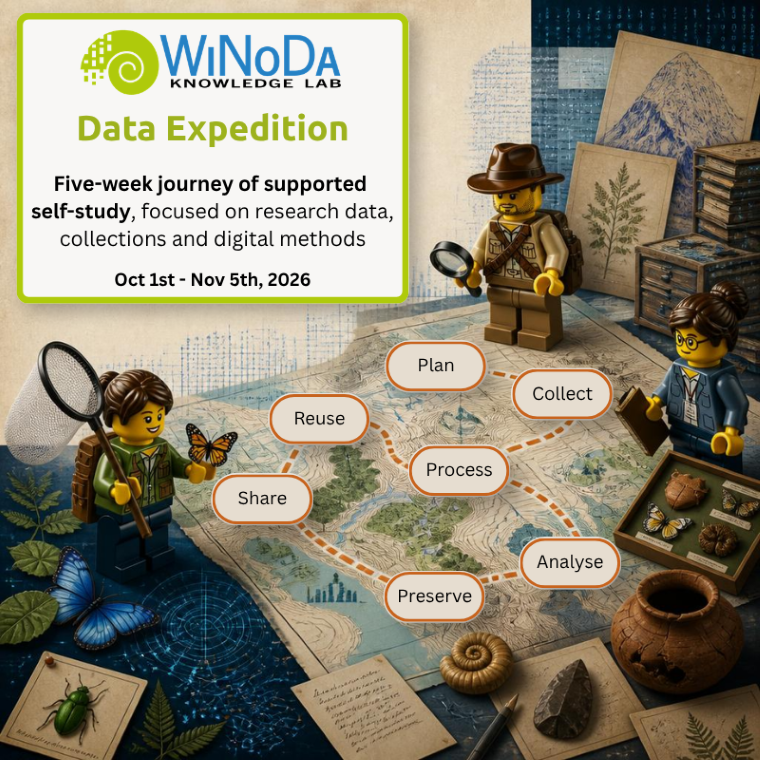
Expedition plan
We’ll all be starting together on
- Thursday, 1 October 2026, 10.00 am–12.00 pm (MESZ | UTC+2), with an online kick-off.
We’ll introduce the courses, answer questions and get to know one another.
Immediately afterwards, you start on you
- data expedition as a guided self-study programme
Over the next five weeks, you’ll work through our self-study courses – at your own pace, whenever you like. As you follow your own learning path through the jungle of the data lifecycle, you can gather, process and analyse new knowledge, and discuss how to apply it in new contexts… Whether you focus on one course or one topic, or want to complete several (all?!? 😯) of our courses, is entirely up to you. For every course you complete, you’ll receive a badge and a certificate.
And if you have any questions along the way, you can discuss them in our forum (https://winoda.de/forum/| ) or attend the open consultation hours.
To wrap things up, we’ll all meet up once more on
- Thursday, 5 November 2026, from 10.00 am -12.00 pm (MEZ | UTC +1) for a joint closing session (online)
We’ll gather round the (virtual) campfire and share stories of our adventures – where did we encounter unexpected obstacles? What treasures were you able to unearth, and how do you intend to apply your newly acquired skills to your work in future?
We’d love to hear how it went for you, how the courses and the format worked out, and what you’d like to see in the second funding phase of WiNoDa…
All our self-study courses are in English. Completion of each course is certified with a certificate.
WiNoDa Data Expedition: https://winoda.de/en/event/winoda-data-expedition/ Register here: https://tinyurl.com/winoda-data-exploration
Registration remains open throughout the data expedition – latecomers are welcome at any time!
Course programme:
- RRP - Reusability and its relevance (Basic, ca. 40 minutes)
- RRP - Reusing object-related research data (Basic, ca. 1.5 hours)
- RDM - Core concepts of data quality in research data management (Intermediate, ca. 1,5 hours)
- RDM - Data Governance. Strategies for quality improvement in collection data (Intermediate, ca. 2 hours)
- Regulatory Frameworks for Data Acquisition in Fieldwork (Basic, ca. 1 hour)
- ATR 1 - Introduction: Basic concepts, terminology and workflow of Automatic Text Recognition (ATR) (Basic, ca. 2 hours)
- ATR 2 - Deep Dive: Preprocessing and software selection (Basic, ca. 1 hour)
- ATR 3 – Deep Dive: Transcription and semantic enrichment (Basic, ca. 1 hour)
- ATR 4 - Deep Dive: Model Training and Publishing (Basic, ca. 1 hour)

Further courses are still in development and will be added to Moodle as soon as they are ready.