
Research data management and open science are important. But that does not mean they always have to be taught through another presentation, another checklist, or another hour of definitions.
What if researchers could solve a mystery, build with LEGO®, escape from a locked room, investigate persistent identifiers, or make decisions about the future of research data instead? There is a surprisingly creative world of games designed to do exactly that.
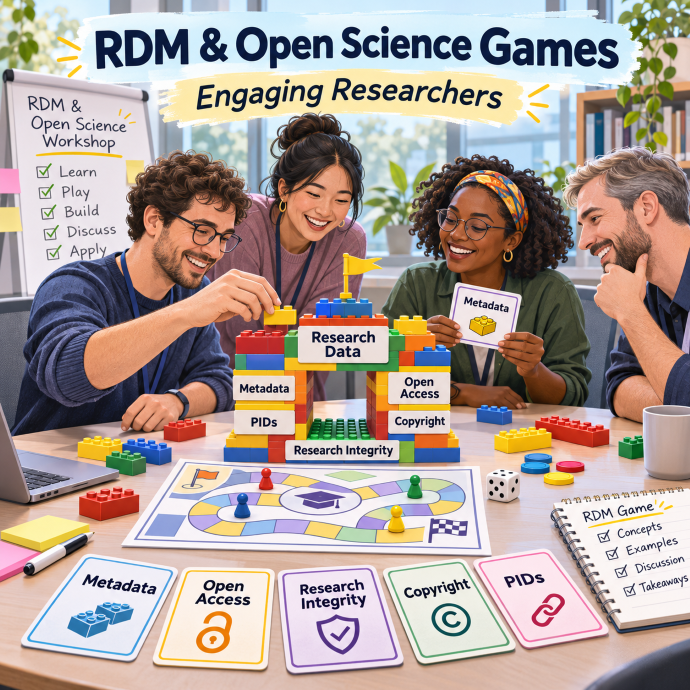
When learning becomes something you do
Many research data management topics are easier to understand when participants have to make decisions themselves.
- Should this dataset be preserved?
- Which metadata are actually necessary?
- What happens when important information is missing?
- Can this material legally be reused?
- Which persistent identifier belongs to which research object?
- And what consequences can today’s publishing decision have several years from now?
Games turn these questions into activities rather than definitions. Instead of simply being told what good practice looks like, participants can discuss, experiment, make choices, make mistakes, and see why those choices matter. That is particularly valuable for topics such as metadata, digital preservation, copyright, Open Access and research integrity, where the answer is often more interesting than a simple “right” or “wrong”.
Metadata with LEGO®? Yes, really.
One of the resources featured in our Knowledge Base is LEGO® Metadata for Reproducibility.
The activity uses LEGO® bricks to make metadata concepts tangible. Participants experience why documenting a process clearly matters when someone else needs to understand, reproduce, or reuse what has been created. It is a professional physical way of approaching a subject that can otherwise become rather abstract rather quickly.
Another example, Curate!, puts players into digital-curation scenarios involving choices about metadata, data formats and long-term preservation.
Both tackle serious RDM questions, but through active participation rather than passive explanation.
Escape rooms, mysteries and difficult decisions
The collection goes much further.
- The Open Access Escape Room uses clues and puzzles to introduce open access principles.
- The Open Access Mystery turns scholarly communication into a collaborative role-playing scenario in which participants investigate a crisis affecting access to research.
- The Open Science Files challenges players to uncover barriers preventing researchers from practising open science.
- And The Dilemma Game takes a different route altogether, confronting researchers with difficult situations involving research integrity and asking them to reflect on the choices they would make.
Different game mechanics, different topics, and the same useful trick: make participants think and become better data managers.
Understanding copyright without the glazed expression
Copyright is another topic capable of producing an interesting workshop.
- Copyright Dough introduces licences and copyright exceptions, while Copyright the Card Game encourages participants to explore how copyright can support research and knowledge sharing rather than treating copyright only as a collection of restrictions.
- The Publishing Trap broadens the discussion by asking players to consider how publishing choices, licences and data-sharing decisions can influence accessibility, scholarly communication and even career progression.
Suddenly copyright is not merely a paragraph in a policy document. It becomes a decision with consequences.
Follow the research data lifecycle.
For those looking for something more directly focused on Research Data Management, the Research Data Management Adventure takes players through different stages of the research data lifecycle, from grant applications through organisation and storage to sharing and publication.
And for persistent identifiers, there is Data Detectives! A Game of Persistent Identifiers: Designed for small groups, Data Detectives challenges participants to recognise different types of persistent identifiers, or PIDs, and understand why they matter.
DOIs, ORCIDs and other identifiers may not initially sound like the ingredients of a thrilling investigation, but science has always been a slightly peculiar place.
More than entertainment
These games are not included simply because they are fun. They can help trainers create opportunities for discussion, active learning and collaborative problem-solving around subjects that researchers encounter throughout the research process. They can be useful in:
- Research Data Management workshops;
- Open Science training;
- doctoral and early-career researcher programmes;
- data-stewardship activities;
- university teaching;
- team meetings;
- conference sessions;
- introductory training on metadata, copyright or publishing.
For trainers working with researchers and natural science collections, games can also provide a useful entry point before moving into more specialised discussions about collection data, documentation, reuse, preservation or publication.
So, which game should you try?
That depends on what you want participants to learn.
- Metadata and reproducibility? There is a game for that.
- Digital preservation? Yes.
- Open Access? Several.
- Copyright? Absolutely.
- Research integrity? Covered.
- Persistent identifiers? Detectives are already on the case.
- Research Data Management across the data lifecycle? That too.
WiNoDa have brought these resources together in the GFBio Knowledge Base to make them easier to discover and explore. The collection includes short descriptions of each game and links to the original resources, giving trainers, data stewards, researchers and educators a starting point for finding activities that fit their own teaching context. This is because sometimes the best way to start a serious conversation about research data is to put the PowerPoint away.

As Knowledge Manager and Helpdesk Support at WiNoDa, I facilitate access to tools, training, and expert guidance in research data management across disciplines. With a strong background as a data steward, I support researchers in making their data FAIR, well-documented, and sustainably reusable.
https://orcid.org/0000-0001-6048-9272