
You have specimens. You have metadata. You may have images, locations, taxonomic information, loans, collectors, publications, and perhaps several decades of records accumulated in files, spreadsheets, and databases.
Now comes the deceptively simple question:
Which database system should you use to manage all of this?
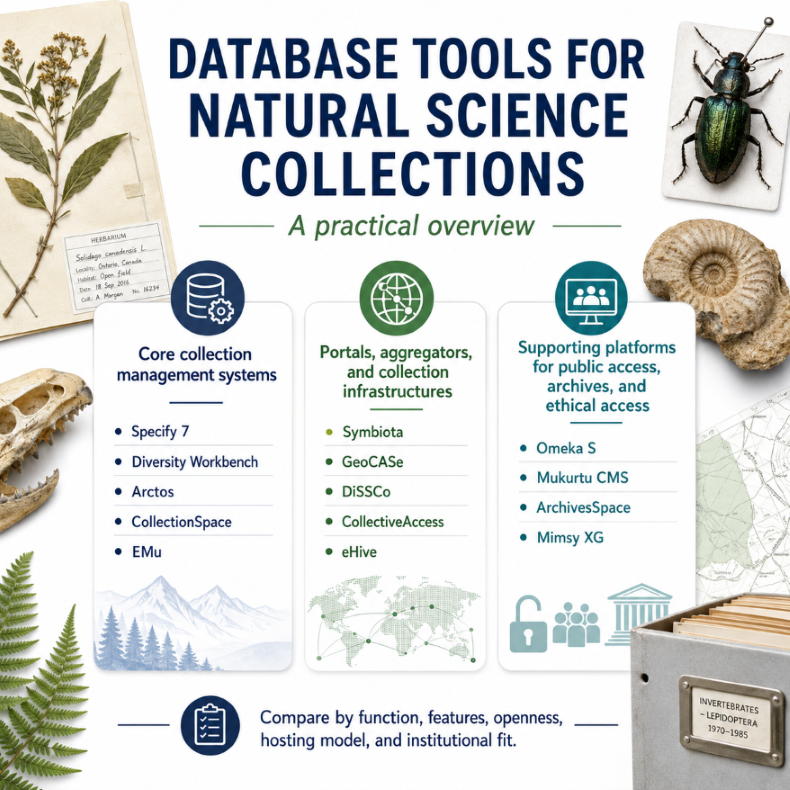
A quick search produces plenty of possibilities. Specify. Diversity Workbench. Arctos. CollectionSpace. EMu. Symbiota. CollectiveAccess. DiSSCo. And then come the portals, cloud platforms, archives and publishing systems.
Suddenly, choosing a database starts to feel like a long-term project. But actually, you do not have too much time for a simple task lke this, right? Don’t worry – we are here to help!
A database is not just a database.
One of the difficulties is that tools used around natural science collections do very different jobs.
Some are full collection management systems, designed to manage specimen records and day-to-day collection workflows.
Others are better understood as portals, aggregators or research infrastructures, helping institutions make collection information discoverable, connect datasets or participate in larger networks.
Still others focus on public access, archives, exhibitions or ethically sensitive access to collection information.
These systems may all appear in a search for “museum database” or “collection database”, but they are not necessarily alternatives to one another. And that distinction matters.
So how do you compare them?
To make the landscape easier to navigate, we created a new overview in the GFBio Knowledge Base: Database tools for natural science collections
The article brings together a range of tools and platforms relevant to natural science collections and object-related data and organises them into three groups:
- Core collection management systems;
- Portals, aggregators and collection infrastructures;
- Supporting platforms for public access, archives and ethical access.
Rather than simply presenting a parade of software names, the tables are designed to help you compare them. For each tool, you can look at questions such as:
What does it actually do?
Is it designed primarily for specimen management, public presentation, data mobilisation or something else?
Is it open source?
And if so, does that also mean your institution has the technical capacity to host and maintain it?
Who is it best suited for?
A large natural history museum may have very different requirements from a small collection or a distributed research network.
How is it hosted?
Self-hosted, cloud-based, vendor-supported, consortium-operated or delivered through a shared infrastructure?
How strongly does it focus on natural history collections?
A very capable general museum system is not automatically the best system for complex specimen-centred data.
What are the limitations?
Because every tool has them. Do softwares without limitations exists?.
There may not be one “best” system
This is perhaps the most important point.
The purpose of the overview is not to rank the tools from best to worst.
A system that works extremely well for one institution may be unnecessarily complex for another. A lightweight cloud platform may be perfectly suitable for a small collection but inadequate for a large institution managing complex specimen relationships. A portal that is excellent for publishing and discovering data may not replace the database used internally to manage the collection.
The useful question is therefore not:“Which tool is the best?”
It is:“Which tool best fits our collections, workflows, technical environment and goals?”
That small change in wording saves quite a lot of database theology.
Start with the landscape
Whether you are exploring a new collection management system, trying to understand how existing platforms differ, or simply wondering what else is available beyond the software you already know, the article is intended as a practical starting point.
Explore the full comparison: Database tools for natural science collections – GFBio Knowledge Base

As Knowledge Manager and Helpdesk Support at WiNoDa, I facilitate access to tools, training, and expert guidance in research data management across disciplines. With a strong background as a data steward, I support researchers in making their data FAIR, well-documented, and sustainably reusable.
https://orcid.org/0000-0001-6048-9272