
Anyone who has ever taught knows that simply providing information is not enough to impart knowledge. As much as one might like to plug a data cable into learners’ necks so that they can learn absolutely everything, from languages to jiu-jitsu – that only worked in the Matrix film series. Unfortunately, it doesn’t work in real life.
In order to learn, we need attention – and we must be willing to pay attention. This means that we humans learn best through personal relationships: with teachers, with fellow learners, and in situational contexts.
And all of that is missing from online courses.
Online courses, and self-study modules in particular, are exceptionally challenging situations from a teaching perspective.
Of course, it is possible to acquire knowledge on your own, using only books. But from an educational perspective, this is the most difficult route. That is why many online teachers choose video as their medium.
Videos offer many advantages: for example, presenters act as points of reference, practical steps can be demonstrated, situations can be portrayed, and real-life contexts can be simulated through staged scenes. This goes well beyond the purely textual level, but it remains a one-way relationship.
Video also has its drawbacks: it is much better suited to learning situations where something needs to be demonstrated than to conveying abstract information.
For example, it is very easy to explain sailing knots, knitting patterns or the angle at which to hold the scissors when cutting roses with the help of videos.
For the concept of ‘FAIR data’, on the other hand, text may actually be the better medium: learners can pause, scroll back, highlight terms, write notes in the margins…
However, in neither case can they ask follow-up questions.
No matter how interactive, entertaining or scenario-based the teaching materials are: unlike in a classroom, the course creator has no way of knowing whether learners have any questions along the way. Are they still able to follow, or have they long since been left behind?
Here, something we usually try to avoid in written communication becomes a virtue: redundancy. Because repeating the same information reinforces the connections in the brain.
Every new topic, every new concept – if we repeat it several times, introduce it, explain it in detail, illustrate it with examples, and summarise it once more; if, in addition, we imbue it with emotion and make it relevant to their own lives through realistic scenarios, then we make it easier for the learners. We explore a topic from various angles until the learners recognise one of them as ‘familiar’, or until we enable them to gain a new perspective on a familiar phenomenon.
It’s all about illustrating things clearly. And the word ‘illlustration’ means “image”. It’s about creating images in the learners’ minds. Strictly speaking, it’s about telepathy.
The art of telepathy – that is, transferring images, emotions, opinions and also information from my mind into the minds of my audience or readership – has been the domain of rhetoric since ancient times. Ancient rhetoric has developed a wide range of exercises and techniques that have stood the test of time.
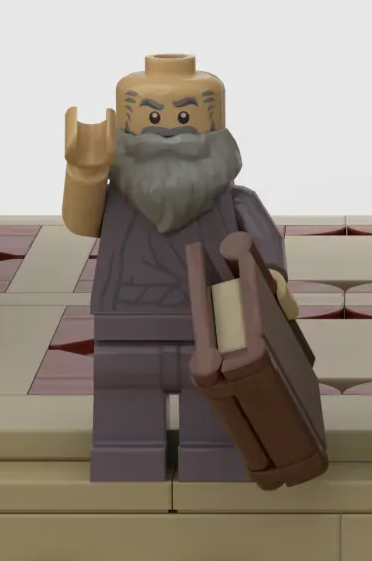
Ancient rhetoric for modern teaching?
Let’s take the ‘Chreia’ (greek for ‘anecdote’) as an example.
In the strict sense, a ‘Chreia’ is an anecdote whose punchline is usually a famous person’s statement or action that is regarded as useful. Closely related to this is the ‘Gnome’ (greek for ‘aphorism’), except that in this case the author of the statement remains unnamed.
In a broader sense, it is a rhetorical exercise that is ideally suited to practising the eulogy as a speech genre, using said anecdote as a starting point.
The Chreia scheme is based on answering seven questions (“Quís, quid, cúr, contrá, simil(e), éxemplária, téstes?” | “Who, what, why, against, similar, examples, witnesses”) and concludes in step 8 with a summary or an appeal.
In shorter versions, several questions are answered in a single sentence; in longer versions, a separate sentence, paragraph or chapter can be written for each step – depending on how much time and patience the guests had at Grandad’s 80th birthday party…
By providing a framework for a comprehensive analysis of a statement, argument or thesis, the Chreia model is also ideally suited to structuring information in teaching materials. Let’s go through the questions one by one and see how this might work in practice.
1. Quis (who)
Laudatio / Propositio (Praise / Thesis): To begin with, mention the person and their action or statement – usually in an approving tone, as being correct or worthy of emulation.
In our context, this would be the thesis of the current section: the most important piece of information to be conveyed in this section or chapter of the teaching materials.
“PIDs support the FAIR principles.”
2. Quid (what)
Explicatio (explanation / elaboration): Paraphrase the information or thesis, define it more precisely and explain it in your own words.
“PIDs make it possible to uniquely identify publications or data, ensuring that they remain discoverable and can be reused.”
3. Cur (why)
Ratio (justification): This section explains why the statement is correct or why the thesis is valid or necessary.
“The Fair principles make it possible to replicate and reproduce scientific research findings. This is a fundamental principle of modern science.”
4. Contra (against)
Contrast or opposite: What would it mean if the opposite of the thesis came true?
“If people, publications or data sets cannot be clearly identified, this can lead to mistakes.”
5. Simile (comparison)
Whether as a comparison, analogy or metaphor: can we find a situation familiar to the learners that works in a similar way and which they can grasp straight away? Graphics, diagrams or illustrations can also serve here.
“An address or a landline number can be used to contact several people in the same household. Mobile numbers, on the other hand, are usually assigned to exactly one person – at least as long as you don’t change the number.”
6. Exemplaria (examples)
Exemplum (example): Provide at least one specific example here to illustrate the thesis, statement or information.
“ORCiD makes it possible to uniquely identify individuals across changes of institution or name, and to distinguish them from people with the same name.”
7. Testes (witnesses)
Testimonium (Testimony / Authority): This is a good place to cite sources, bibliographical references or further information.
“You can find out more, for example, by following this link: https://base4nfdi.de/projects/pid4nfdi…“
8. Conclusio / Complexio (conclusion)
(Conclusion): Finally, there is a brief summary. This could be a table, a list of the key points or a call to action.
“Use PID and, if you haven’t already done so, start by creating an ORCiD.”
Summary
Of course, a framework like this serves only as a guide – it is meant to be a handrail, a guardrail, not a cage. For me, Chreia’s list of questions is a helpful tool, not a constraint. It is not always useful to imagine the opposite, nor is it always necessary to justify a statement.
I can adapt the list as I see fit, depending on the topic or thesis, but by running through it in my mind, I ensure that I examine the topic from various angles and do not overlook any aspect.
What might this look like in practice?
We have published some brand-new courses this week:
From our course series “Advanced RDM Concepts in Managing Natural Science Collections”
- RDM – Core concepts of data quality in research data management
and from our course series “Research, reuse, and publication of object-related data according to the FAIR principles”
- RRP – Reusability and its relevance
- RRP – Reusing object-related research data

Now also available on Moodle:
- 2024 WiNoDa Webinar Series: Data Science

More courses are in the pipeline...
Give our online courses a go – register easily and free of charge at www.moodle.winoda.de!
https://www.lin-magdeburg.de/brain-facts/wie-funktionieren-lern-und-gedaechtnisprozesse
https://de.wikipedia.org/wiki/Chrie
https://en.wikipedia.org/wiki/Chreia
Quintilia: Institutio oratoria 1,9,4: https://www.thelatinlibrary.com/quintilian/quintilian.institutio1.shtml
As an academic staff at the DAI, my main responsibility for WiNoDa lies in the creation of self-study courses on discipline-specific data literacy.
Hands-on and interactive – my goal is: less technical jargon, more “aha” moments.
Because we are all working with data!