
How quickly time flies when you’re having fun!
There’s a reason for the long silence on our blog – it may have looked like we were hibernating, but we have been working flat out to create our self-study courses, spruce up our Moodle platform, set up the community forum and test everything twice and thrice for content accuracy, technical functionality, design consistency and, of course, accessibility. All materials will also be made available in our repository under a CC BY licence in the long term.
I say ‘we’ because I am by no means the only one creating Open Educational Resources (OER) for WiNoDa – our entire team contributes its diverse expertise. Many of the self-study courses are created collaboratively.
This is how we proceed: We use the learning objective matrix for research data management from Dini-Nestor AG Forschungsdaten to define content that is tailored to our target groups.
First, we discuss the planned course content together, then select suitable learning objectives appropriate to the course level, adapt them to the needs of our target groups if necessary, and presto: the basic framework for the course structure is in place!
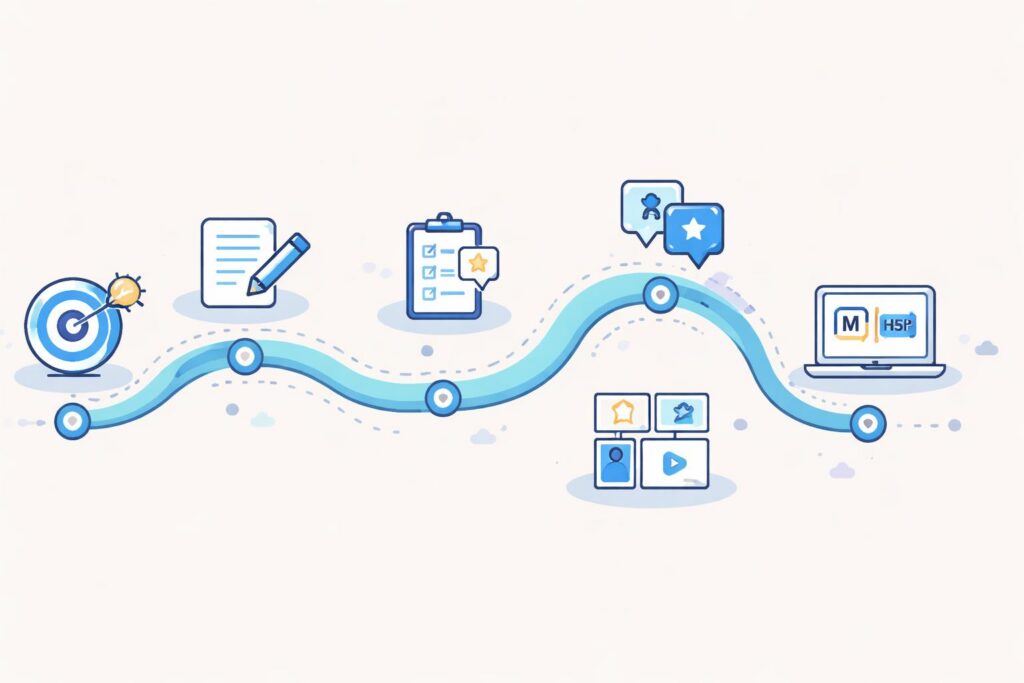
Each of us creates either a standalone course chapter (or several) or an entire course (or several, or both). Thanks to the LZM, we can easily check whether and which learning objectives we may be covering multiple times or in different courses, avoid content overlaps, and enable targeted cross-references to related courses.
Of course, each of us has our own workflow for developing the actual scripts.
I can only speak for myself when it comes to how I work with the learning objective matrix and what has proven successful for me.
I wanted to take as modular an approach as possible to ensure that the materials could be reused as effectively as possible. To do this, I created a document in Obsidian with the course description and a list of learning objectives for each part of the course.
For each of ‘my’ learning objectives, I created a separate document with the name of the learning objective ID, which contains the technical text for the learning objective at an appropriate level. A document for a learning objective such as ‘Learners can name the term XYZ’ might only contain a short definition or the explanation of an acronym. A (linked) document for the related learning objective ‘Learners can explain the term XYZ’ would contain the explanation of the term.
For each of these texts, I then noted down various quiz questions, which also have the learning objective ID in their name – e.g. ‘LO-ID_Multiple-Choice_1’.
The LO-ID links the course schedule, learning material and knowledge assessment/activity in a way that is always traceable and can be assigned at a glance.
The approach is structured and systematic in an almost repulsive way, allowing me to keep a precise overview. I can ensure that I cover all previously defined content, release the content (as individual files) for peer review, and ensure that all test questions can actually be answered based on the technical text.
In addition, Moodle provides us with a learning management system that is almost too powerful. Even though we do not have to (or want to) award or manage exam grades, we try to take advantage of some of the possibilities it offers.
Moodle allows us to create competency frameworks and link them to courses. According to my initial research, we should be able to map the LOM to a competency framework – then we could display the learning objectives covered in learning plans and issue badges and certificates.
This could create transparency for our participants and support their expectation management.
At least, that’s the plan – as soon as I’ve figured out exactly how we can/must implement this technically, I’ll report back.
With that in mind – there’s still a lot to do!
WiNoDa self-study courses (work in progress) https://winoda.de/en/educational-resources/
WiNoDa Community Forum (open for registration): https://winoda.de/login/