
In the first two parts of this series, I discussed two well-established and widely used sets of principles for contemporary scientific work: FAIR and CARE. I showed how condensing them into an acronym that resembles a positively connoted and similar “correct” word positively influences their acceptance and dissemination, and how the subversive effect of the rhyme helps CARE to build on the acceptance of FAIR.
Now I would like to try and see if I can reproduce the recipe for success used by FAIR and CARE…
Because all my thoughts on the linguistic magic of acronyms began when I was looking for a catchphrase, a collection of principles condensed into a mnemonic device that summarizes the necessary scientific approach to a specific research situation as a set of instructions:
How do you deal with ideologically biased sources?
I was firmly convinced that the collection of principles I was looking for must already exist. None of the steps contained therein are novel, unusual, specific to a particular disciplinary community, or controversial.
But I could not find a single instance in which they had been explicitly compiled or even published under a catchy name—as a meaningful acronym!
So I created the CAREFUL principles myself (and published them with Data Clues).[1]
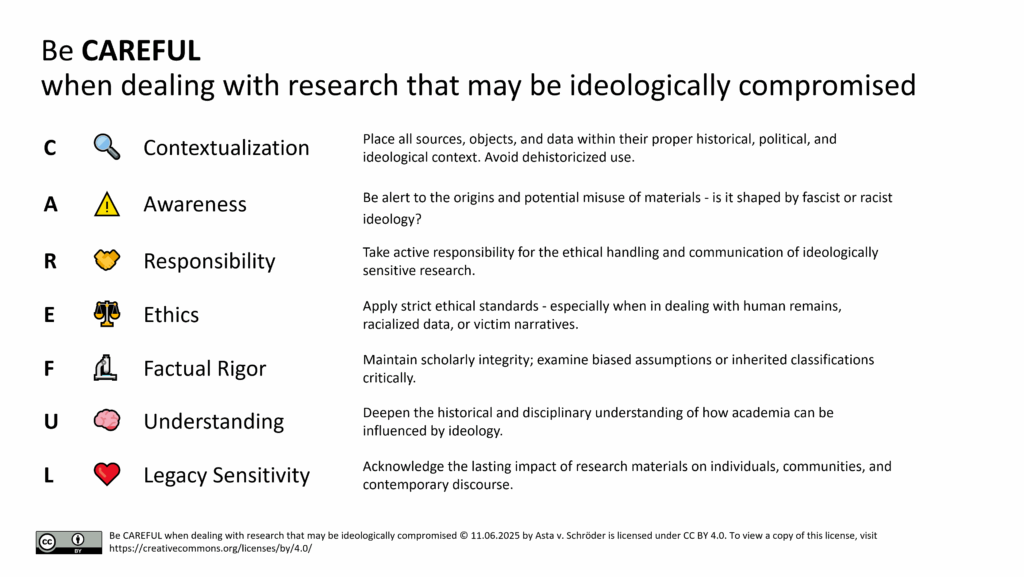
C stands for Contextualization – the historical, political, and ideological embedding of research, data, and objects
A stands for Awareness – awareness of the origin, burden, and historical impact of sources
R stands for Responsibility – the active assumption of responsibility by institutions and researchers
E stands for Ethics – ethical reflection in dealing with sensitive materials (e.g., human remains, racist classifications)
F stands for Factual rigor—scientifically sound, verifiable working methods based on transparent values
U stands for Understanding—a deeper historical understanding of concepts and theories (e.g., Nazi research Logic in biopolitics, racism, anthropology)
L stands for Legacy sensitivity – sensitivity to the aftermath of research and the suffering of those affected and their descendants
Careful – both cautious and meticulous.
The CAREFUL principles are intended to raise awareness regarding the necessity for consistent scientific diligence and methods, thereby ensuring ethical vigilance, critical awareness, and historical responsibility toward ideologically compromised sources.
As with the Ice Age carvings we presented in Data Clues: their discovery in 1931 earned Gustav Riek a long academic career [2],[5] and international recognition. However, be careful.
I do not wish to elaborate here how prehistoric research in particular was appropriated by the Nazis to legitimize their “racial doctrine.” The völkisch tradition of Alfred Rosenberg’s “Reichsbund für Vorgeschichte” (Reich Association for Prehistory), its power and cultural-political rivalry with Heinrich Himmler’s “SS-Ahnenerbe” (SS Ancestral Heritage), and both of their pseudoscientific propaganda have been studied since the 1970s.
Today, it is clear that any research from this period could be ideologically contaminated.
Indeed, Gustav Riek had been a member of the NSDAP since 1929, a member of the SA since 1933, and a member of the SS since 1937. From 1941 onwards, he worked in the SS Ancestral Heritage Department and on Himmler’s personal staff. During the war, he served in a concentration camp and as a geologist in the Waffen-SS. [3]
However, his denazification file explicitly stated that he “had stood manfully on the side of true science in prehistoric research (against the Nazi pseudoscience of Reinerth and Rosenberg in particular)…”[4]
On the other hand, in a popular fictionalized story about his findings from 1934, he described “how mammoth hunters had first fought for their habitat in the Lone Valley and exterminated the Neanderthal groups living there—an idea shaped by the ideology of the 1930s, for which there is still no archaeological evidence today.” [5] The latest new edition of the story dates from 2014 – at least it includes a critical assessment by Nicholas Conard and Ewa Dutkiewicz.[6]
Whether Riek was a die-hard Nazi or “just” a child of his time, when nationalistic ideas about the superiority of Homo sapiens and other social Darwinist myths were widespread, I cannot say conclusively.
But examining the literature on prehistoric finds from the Nazi era with Contextualization, Awareness, Responsibility, Ethics, Factual rigor, Understanding, and Legacy sensitivity led me to a more nuanced picture of Gustav Riek’s legacy.
Of course, ideological influence is not limited to Nazi Germany.
Right now, scientific research (e.g., on climate change or vaccines) is under immense pressure in the US. Studies on history, racism, or gender are being attacked as “woke” by the highest authorities.
Not only then, but especially when scientific research is so obviously influenced and abused for political or religious culture wars, researchers must be careful.
[1] von Schröder, Asta, Petersen, Jannis. (June, 2025). „Data Clues“. A material knowledge graph. Zenodo. https://doi.org/10.5281/zenodo.15804032
[2] Riek, G. (1934). Die Eiszeitjägerstation am Vogelherd im Lontal. Akademische Buchhandlung.
https://zenon.dainst.org/Record/000908841
[3] von Bremen, B. (2020). NS-Akteure in Tübingen. Kurzbiografie Gustav Riek; Geschichtswerkstatt Tübingen e.V. https://www.ns-akteure-in-tuebingen.de/biografien/bildung-forschung/gustav-riek
[4] Landesarchiv Baden-Württemberg, Abt. Staatsarchiv Sigmaringen—Findbuch wü 13 t 2: Staatskommissariat für die politische Säuberung. (1949, November 13). [Personenakten: Riek, Gustav, Prof. Dr.]. http://www.landesarchiv-bw.de/plink/?f=6-461265-1 (my translation, assisted by DeepL)
[5] Der abenteuerliche Weg der Vogelherd-Figurinen – von ihrer Auffindung bis heute. (2022, August 2). Kerns Verlag Tübingen. https://kernsverlag.com/de/der-abenteuerliche-weg-der-vogelherd-figurinen-von-ihrer-auffindung-bis-heute/ (my translation, assisted by DeepL)
[6] Riek, G., Conard, N. J., & Dutkiewicz, E. (2014). Die Mammutjäger vom Lonetal. Hess.
Incidentally, WiNoDa is planning a whole series of webinars for the 2025 winter semester on the professional handling of data from sensitive contexts and data ethics: “From archive to action: ethics for data in sensitive contexts.” We will post more detailed information soon!