There is a quote by William Gibson, science fiction author, that goes: “The future is already here, it’s just not evenly distributed.”
The same is true in the research landscape with regard to IT skills and data literacy. In Germany in particular, where there is still no basic IT education in schools and, due to the federal system, no standardized minimum requirements, the prior knowledge necessary for successful research data management is highly heterogeneous.
That is why one of WiNoDa’s core tasks is to create online self-study courses for the “acquisition of technical and methodological skills.” In plain language: Moodle courses for the groups of people we have defined in our personas (researchers of earth and human history, but also people who work in and with natural history collections).
“Kai Collection Curator” is faced with the task of digitizing his analog collection and making it accessible—but what is the best way to go about this?
“Anita”, a doctoral student in archaeobotany, and “Susan”, an established dragonfly researcher, are experts in their fields but need support to fully exploit the possibilities of modern data-driven research—either because data skills were not taught during their studies or because the field is developing rapidly.
“Dave Data Enthusiast” has all the IT skills, but may need knowledge of open science practices or domain-specific background knowledge.
Our task is therefore to impart knowledge and skills in the field of research data management—but tailored to the specific needs of people who work and conduct research with natural history objects.
Because we cannot assume any general basic knowledge, we as producers of teaching materials must first find out where we need to “pick up” our community. What do Anita, Kai, Susan, and Dave already know, and what do they need?
My colleague Sophie Kobialka has just conducted a qualitative study as part of her master’s thesis to ask those “concerned” what they feel is lacking, using a bottom-up approach. (A blogpost will follow!)
Conversely, DINI-nestor AG Research Data took on the challenge in 2022 to define top-down standardized requirements within the framework of a learning objective matrix on the subject of research data management. The third revised version was published on Zenodo in March 2025.
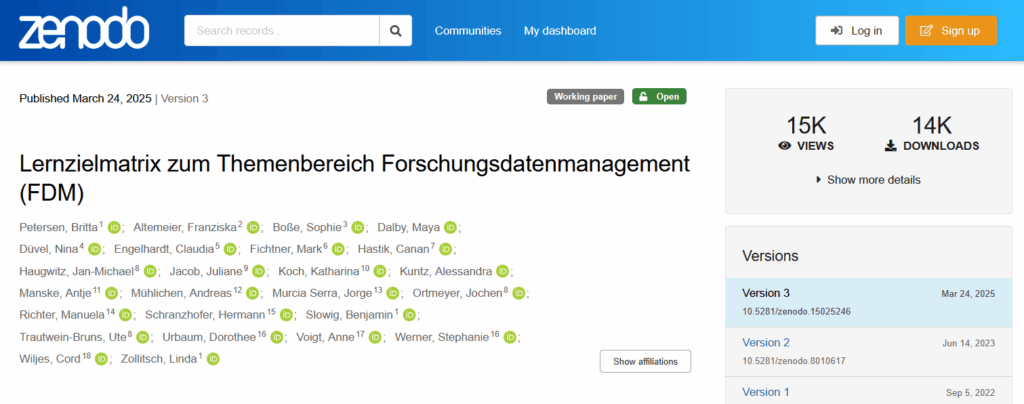
For us data competence centers, the LOM is a great help—it lists over 1,000 learning objectives in six subject clusters. The individual learning objectives are assigned to the levels of knowledge, understanding, application, etc., as well as to factual, methodological, personal, or social competence, using Bloom’s taxonomy and descriptive verbs (name, explain, apply, discuss, etc.). There are also recommendations for targeting the learning objectives to educational levels: bachelor’s, master’s, PhD, data steward.
This assignment of learning objectives to supposed academic competence levels does not (yet) work so well, in my humble opinion, due to the aforementioned differences in prior knowledge among individuals. It would be better to divide them according to the training purpose (here, for example, “data steward”), because this also determines the teaching format within certain limits: Is it “just” knowledge that is to be imparted (Moodle courses, lectures), or should learners be able to apply something (hands-on webinars, hackathons, winter school)?
The LOM supports the tailored adaptation of teaching materials to the planned format. Even if the declension of learning objectives using Bloom’s verbs seems small-scale and redundant at first glance (“can name/explain/apply data licenses…”), it helps to focus on the relevant skill at hand—and also on the appropriate methods for testing or certifying it. And—without claiming to be complete—no topic area is forgotten…
The LOM is a living document that is explicitly intended to be expanded and adapted to specific subjects. This is wonderful, because the field is constantly evolving. Above all, however, it enables fundamental didactic reflection on one’s own teaching, its goals, and the appropriateness of methods and assessments—something that is unfortunately still often neglected in higher education.
It fills a real need—over 14,000 downloads prove it.
The (German) RDM-Learning Objective Matrix can be found here: https://zenodo.org/records/15025246
Edit: The English version was published July 9, 2025 on Zenodo: https://zenodo.org/records/15846806
Further information on its development and use (in German only): https://www.forschungsdaten.org/index.php/Lernzielmatrix
Open consultation hour “Ask the Matrix” every second Friday of the month, 10:00-11:00 a.m., online.
The next scheduled dates are September 12, 2025, October 10, 2025.
https://forschungsdaten.info/kalender-index/kalender-anzeige/termin/ask-the-matrix-offene-sprechstunde-zur-lernzielmatrix-2
Information on WiNoDa events can be found here: https://winoda.de/en/events
A (recently updated) announcement of the online self-study courses that WiNoDa is currently developing can be found here: https://winoda.de/en/educational-resources